
Time and place
Iraq
These dates mark the focus of this case, not the full history of the place or its communities.
States + empires · Settlement · Iraq
4000 BCE–2000 BCE (focus interval)
What belongs in a history of a city beyond its walls?
The heritage property brings together Uruk, Ur and Eridu with four wetland areas in southern Iraq. Reading the cities alongside their surroundings raises questions about the environments that supported settlement.
Iraq · 4000 BCE–2000 BCE (focus interval)
These points locate named sites or parts of a listed property. They show geographic references, not ancient borders or excavation plans. They make no claim about present-day sovereignty.
● Published reference point. Natural Earth public-domain land outline. No political boundaries are shown. The map does not capture scrolling.
Published heritage component reference; not excavation geometry or ancient territorial boundary. Present-day geographic reference for the named site/component; does not date an occupation or establish a territory.
31.3242°, 45.6372° · Coordinate source ↗
1481-005 · Uruk Archaeological City · Iraq · N31 19 27 E45 38 14
Coordinate source checked 2026-10-27.
Published heritage component reference; not excavation geometry or ancient territorial boundary. Present-day geographic reference for the named site/component; does not date an occupation or establish a territory.
30.9631°, 46.1031° · Coordinate source ↗
1481-006 · Ur Archaeological City · Iraq · N30 57 47 E46 6 11
Coordinate source checked 2026-10-27.
Published heritage component reference; not excavation geometry or ancient territorial boundary. Present-day geographic reference for the named site/component; does not date an occupation or establish a territory.
30.8169°, 45.9958° · Coordinate source ↗
1481-007 · Tell Eridu Archaeological Site · Iraq · N30 49 1 E45 59 45
Coordinate source checked 2026-10-27.
Iraq
These dates mark the focus of this case, not the full history of the place or its communities.
The listed property combines three archaeological sites with four wetland areas in southern Iraq.
The remains of buildings and the condition of mud brick help distinguish surviving architecture from a reconstruction.
The modern wetland property is not an ancient political boundary or proof of a single uninterrupted landscape.
The DAI project text was read. The related van Ess paper was available as an abstract, but the full PDF could not be retrieved. Project descriptions may overlap the excavations summarized by UNESCO.
Source links apply to specific claims. Several links can lead back to the same study. Read what each source supports.
What remains uncertain
The modern wetland property is not an ancient political boundary or proof of a single uninterrupted landscape.
Institutional primary description; introductory synthesis
Description and statement of Outstanding Universal Value
What remains uncertain
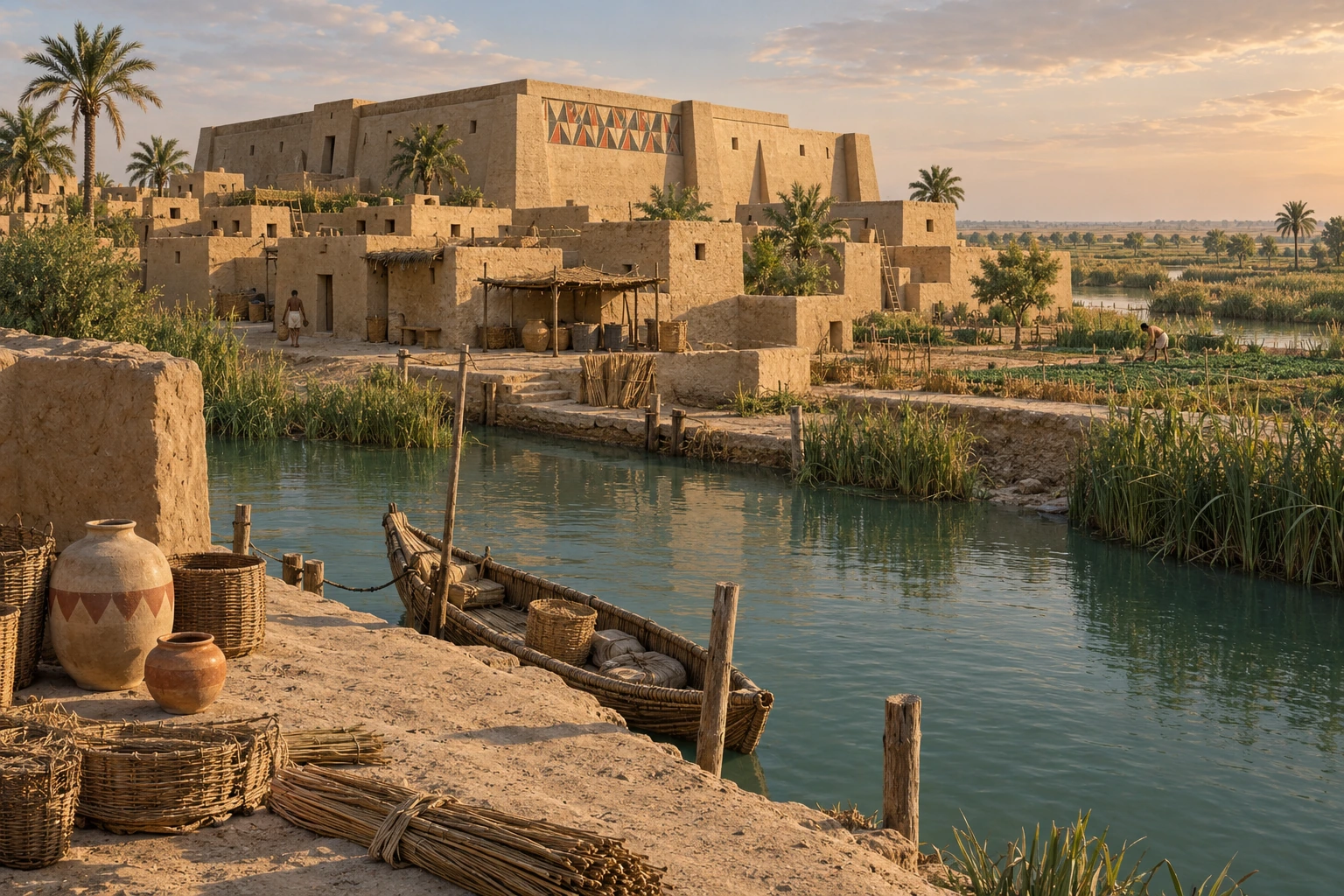
Modern reconstructions include interpretation; they are not photographs of intact ancient buildings.
Excavation-project architectural account
Überblick, paragraphs 2–3
What remains uncertain
Room function and original appearance do not have equal certainty.
Architectural inference
Überblick, paragraph 3
The remains of buildings and the condition of mud brick help distinguish surviving architecture from a reconstruction.
Limit: The modern wetland property is not an ancient political boundary or proof of a single uninterrupted landscape.
UNESCO World Heritage Centre: Uruk, Ur and Eridu ↓Rebuilding and erosion help explain the gap between monumental plans and low surviving walls.
Limit: Preservation is uneven.
German Archaeological Institute: Visualisierung der antiken Stadt Uruk ↓A reconstruction translates architectural documentation into a proposed appearance.
Limit: Distinguish recorded foundations from reconstructed upper structures.
German Archaeological Institute: Visualisierung der antiken Stadt Uruk ↓The listed property combines three archaeological sites with four wetland areas in southern Iraq.
Institutional primary web account inspected 27 October 2026; no fieldwork or independent peer review claimed
Several links may describe the same research. Shared authors or data can limit how much independent confirmation they provide.
Mud-brick survival and the evidence behind architectural reconstruction.
Primary institutional/project text inspected 27 October 2026; specified body sections read
Several links may describe the same research. Shared authors or data can limit how much independent confirmation they provide.