
Time and place
Egypt
These dates mark the focus of this case, not the full history of the place or its communities.
States + empires · Institutions · Egypt
2700 BCE–2200 BCE (focus interval)
Whose lives become most visible in monumental remains?
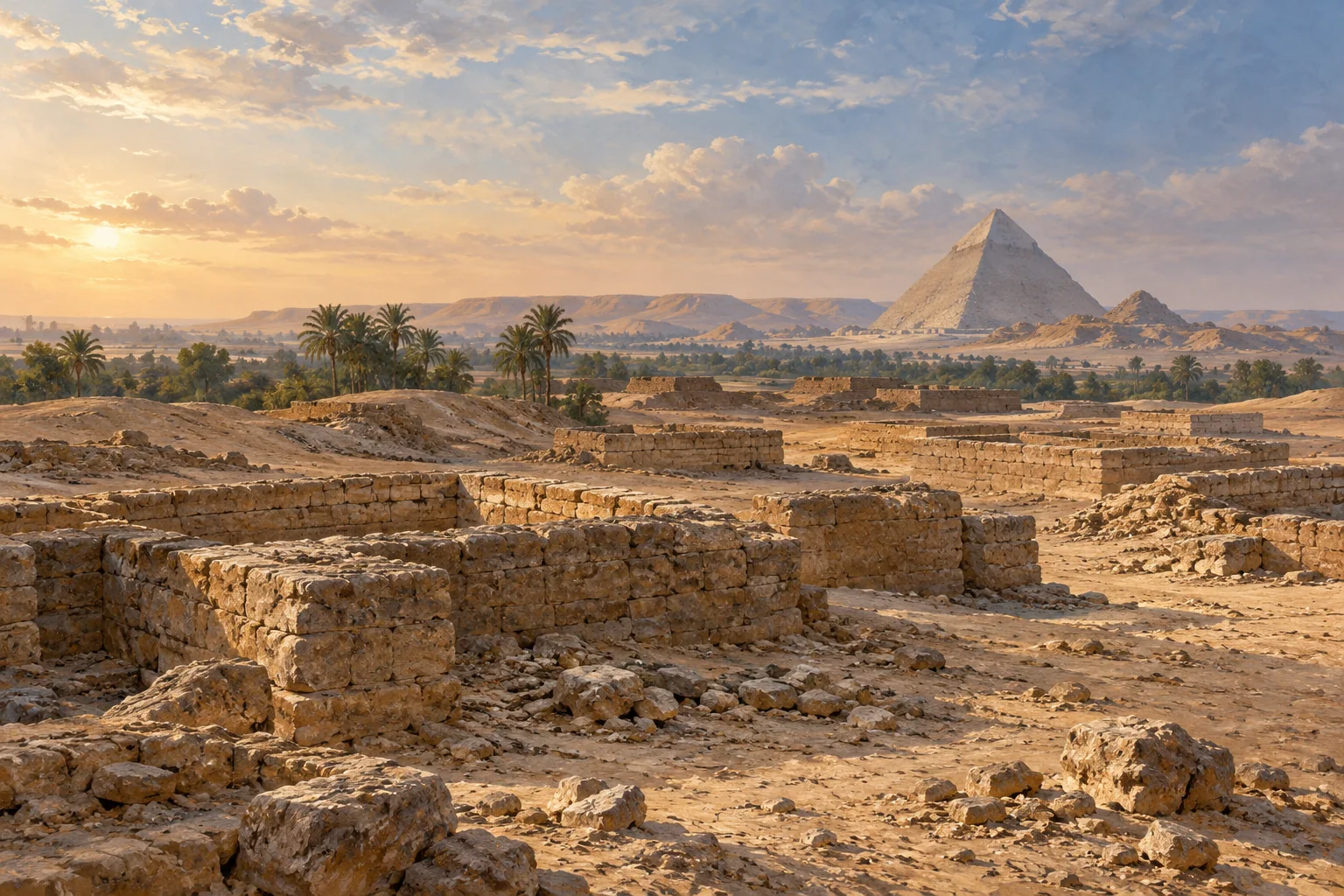
Pyramids, mastabas, rock tombs and temple remains survive in the Memphis necropolis. They provide evidence of funerary building and institutions, while leaving much of household life outside this case.
Egypt · 2700 BCE–2200 BCE (focus interval)
These points locate named sites or parts of a listed property. They show geographic references, not ancient borders or excavation plans. They make no claim about present-day sovereignty.
● Published reference point. Natural Earth public-domain land outline. No political boundaries are shown. The map does not capture scrolling.
Published heritage component reference; not excavation geometry or ancient territorial boundary. Present-day geographic reference for the named site/component; does not date an occupation or establish a territory.
29.8555°, 31.2611° · Coordinate source ↗
86-001 · Site of Memphis · Egypt · N29 51 19.8 E31 15 39.8
Coordinate source checked 2026-10-27.
Published heritage component reference; not excavation geometry or ancient territorial boundary. Present-day geographic reference for the named site/component; does not date an occupation or establish a territory.
29.9760°, 31.1304° · Coordinate source ↗
86-002 · Pyramid fields from Giza to Dahshur · Egypt · N29 58 33.744 E31 7 49.476
Coordinate source checked 2026-10-27.
Egypt
These dates mark the focus of this case, not the full history of the place or its communities.
The Memphis necropolis includes pyramids, mastabas, rock tombs and temple remains.
Work around tombs provides one view of a city; it cannot stand for every activity or every period of Egyptian history.
Royal monuments do not supply a complete account of household life or every period of Egyptian history.
AERA’s Kom el-Fakhry work concerns First Intermediate Period homes and a cemetery. It cannot be inserted into an Old Kingdom account without keeping those dates separate. Independent review of the wider interpretation remains open.
Source links apply to specific claims. Several links can lead back to the same study. Read what each source supports.
What remains uncertain
Royal monuments do not supply a complete account of household life or every period of Egyptian history.
Institutional primary description; introductory synthesis
Description and statement of Outstanding Universal Value
What remains uncertain
One excavated settlement does not describe every pyramid worker or Egyptian household.
Excavators’ institutional fieldwork account
The Lost City of the Pyramids
What remains uncertain
A cult settlement and a building workforce are distinct contexts.
Settlement and institutional interpretation
Khentkawes Town & the Menkaure Valley Temple
Work around tombs provides one view of a city; it cannot stand for every activity or every period of Egyptian history.
Limit: Royal monuments do not supply a complete account of household life or every period of Egyptian history.
UNESCO World Heritage Centre: Memphis ↓Settlement archaeology adds workers and administrators to a history otherwise dominated by royal monuments.
Limit: Keep Giza’s local context explicit.
Ancient Egypt Research Associates: Fieldwork ↓Housing and ritual institutions offer different kinds of evidence within the necropolis landscape.
Limit: Do not extrapolate one settlement across ancient Egypt.
Ancient Egypt Research Associates: Fieldwork ↓The Memphis necropolis includes pyramids, mastabas, rock tombs and temple remains.
Institutional primary web account inspected 27 October 2026; no fieldwork or independent peer review claimed
Several links may describe the same research. Shared authors or data can limit how much independent confirmation they provide.
Settlements and labor/institutional contexts within the Memphite necropolis landscape.
Primary institutional/project text inspected 27 October 2026; specified body sections read
Several links may describe the same research. Shared authors or data can limit how much independent confirmation they provide.