
Time and place
Pakistan
These dates mark the focus of this case, not the full history of the place or its communities.
States + empires · Settlement · Pakistan
2600 BCE–1900 BCE (focus interval)
What can a plan tell us before we name its rulers?
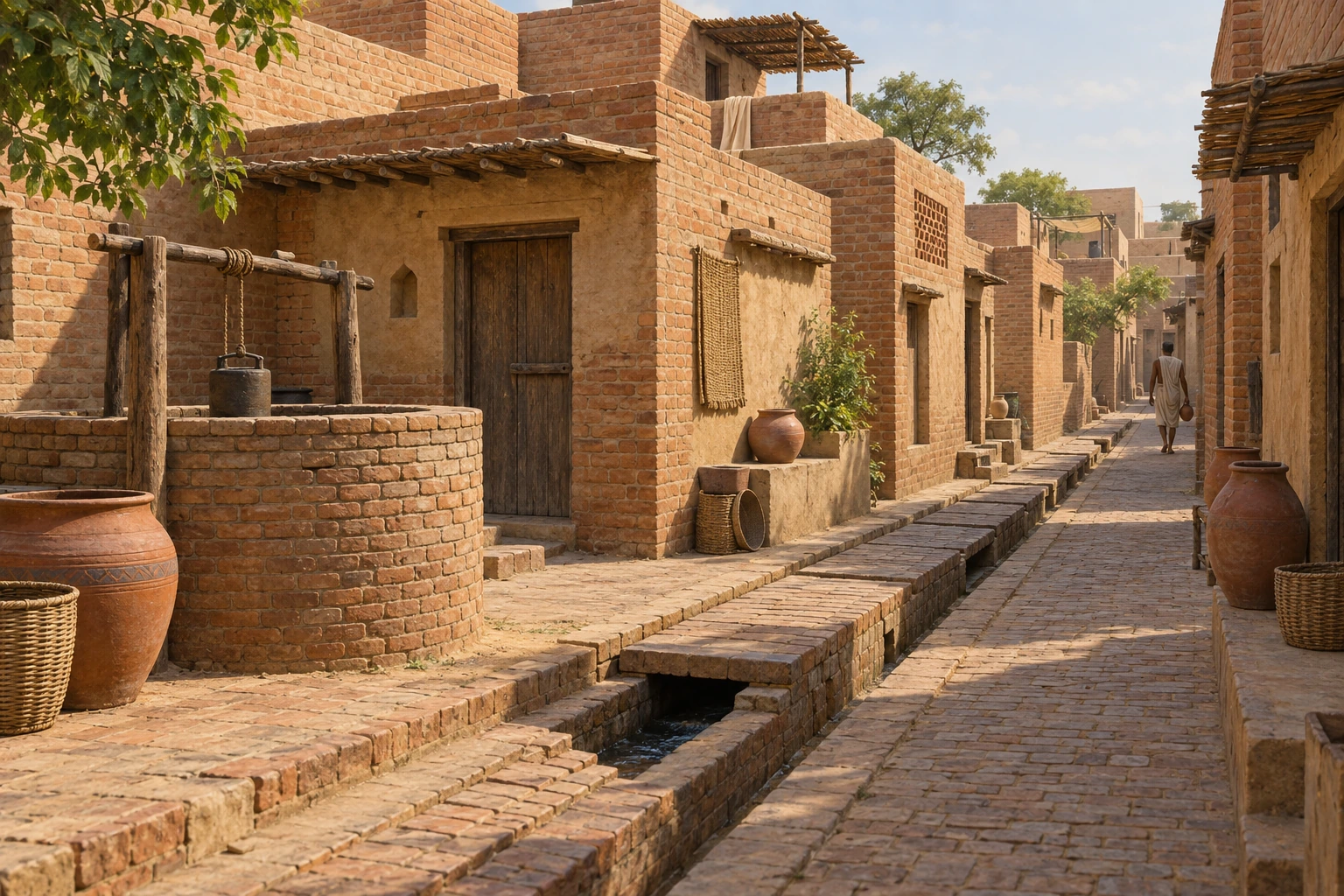
Mohenjo-daro’s surviving city plan raises a practical question: how were shared spaces and infrastructure coordinated? Its ordered layout alone cannot identify rulers or tell us which language residents spoke.
Pakistan · 2600 BCE–1900 BCE (focus interval)
These points locate named sites or parts of a listed property. They show geographic references, not ancient borders or excavation plans. They make no claim about present-day sovereignty.
● Published reference point. Natural Earth public-domain land outline. No political boundaries are shown. The map does not capture scrolling.
Published heritage-property reference point; not an excavation coordinate or ancient boundary. Present-day geographic reference for the named site/component; does not date an occupation or establish a territory.
27.3292°, 68.1389° · Coordinate source ↗
N27 19 45 E68 8 20
Coordinate source checked 2026-10-27.
Pakistan
These dates mark the focus of this case, not the full history of the place or its communities.
The third-millennium BCE archaeological city preserves a structured urban layout.
Drainage and the city plan can be examined without assuming a particular constitution or ruler.
The plan alone cannot identify rulers, a system of government or the residents’ language.
The drainage study was inspected through its abstract. Harappa.com’s account is a synthesis of earlier research, not a newly reviewed excavation report. Independent review remains open.
Source links apply to specific claims. Several links can lead back to the same study. Read what each source supports.
What remains uncertain
The plan alone cannot identify rulers, a system of government or the residents’ language.
Institutional primary description; introductory synthesis
Description and statement of Outstanding Universal Value
What remains uncertain
An abstract does not expose all calculations, assumptions or counterexamples.
Engineering interpretation reported in abstract
English abstract, concluding sentence
What remains uncertain
These parameters do not establish a modern-style sewer system or a form of government.
Method description reported in abstract
English abstract, method description
Drainage and the city plan can be examined without assuming a particular constitution or ruler.
Limit: The plan alone cannot identify rulers, a system of government or the residents’ language.
UNESCO World Heritage Centre: Mohenjo-daro ↓Drains can be studied in relation to rooms and wells, rather than named as a generic sanitation system.
Limit: The proposed function remains an interpretation.
Nakamura et al. (1995): Reconsideration of water supply-drainage system at Mohenjo-Daro ↓Engineering questions complement archaeological plans.
Limit: Full-paper methods and archaeological source dependence still need review.
Nakamura et al. (1995): Reconsideration of water supply-drainage system at Mohenjo-Daro ↓The third-millennium BCE archaeological city preserves a structured urban layout.
Institutional primary web account inspected 27 October 2026; no fieldwork or independent peer review claimed
Several links may describe the same research. Shared authors or data can limit how much independent confirmation they provide.
Engineering interpretation of drainage purpose.
Primary journal English abstract inspected 27 October 2026; Japanese full text not reviewed
Several links may describe the same research. Shared authors or data can limit how much independent confirmation they provide.