
Time and place
Greece
These dates mark the focus of this case, not the full history of the place or its communities.
States + empires · Institutions · Greece
1500 BCE–1100 BCE (focus interval)
How should we read a fortress alongside a later story?
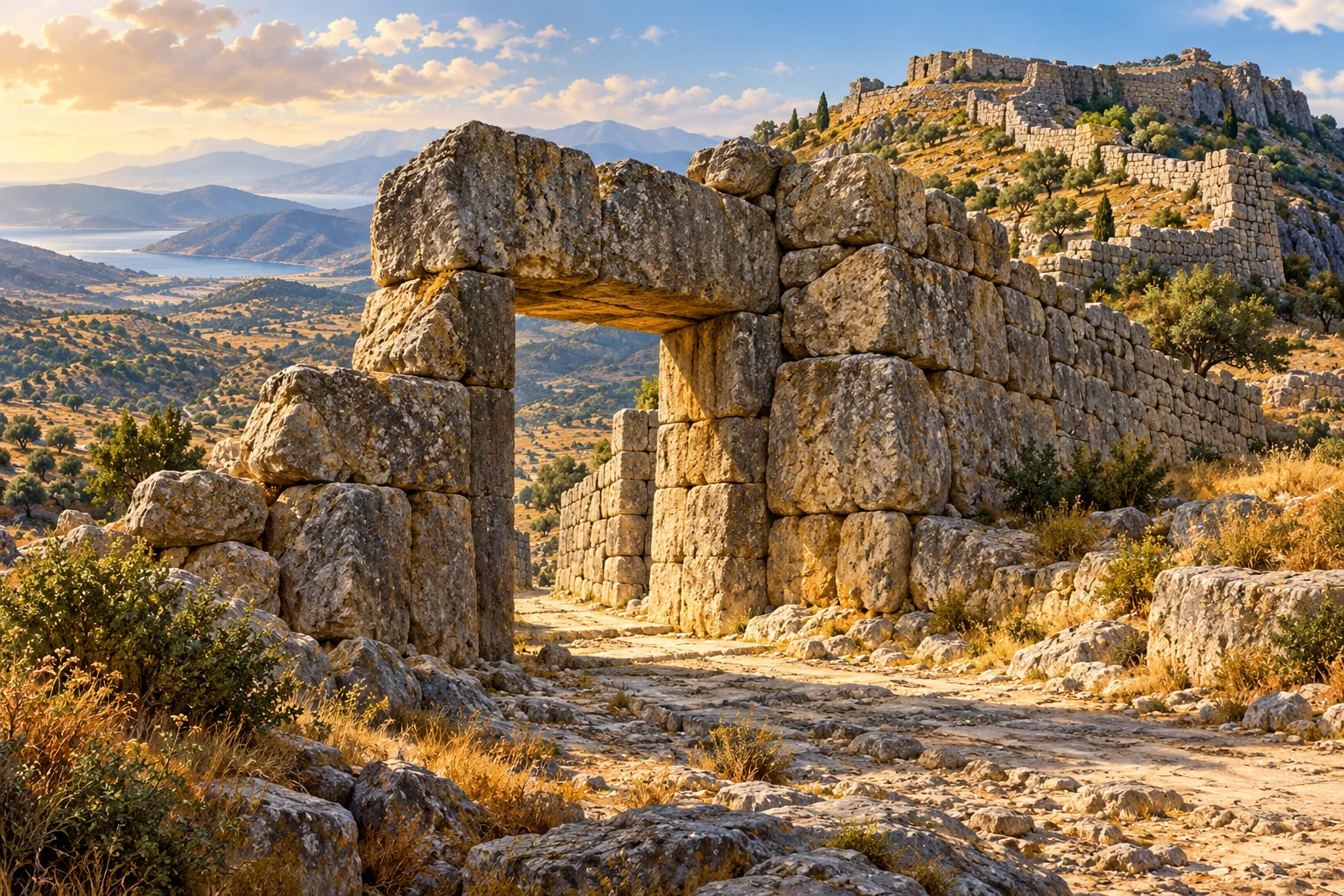
Fortified centers survive at Mycenae and Tiryns. Their buildings and associated pottery can be studied separately from the later literary traditions linked to these places.
Greece · 1500 BCE–1100 BCE (focus interval)
These points locate named sites or parts of a listed property. They show geographic references, not ancient borders or excavation plans. They make no claim about present-day sovereignty.
● Published reference point. Natural Earth public-domain land outline. No political boundaries are shown. The map does not capture scrolling.
Published heritage component reference; not excavation geometry or ancient territorial boundary. Present-day geographic reference for the named site/component; does not date an occupation or establish a territory.
37.7333°, 22.7500° · Coordinate source ↗
941-001 · Archaeological Site of Mycenae · Greece · N37 43 60.00 E22 45 0.00
Coordinate source checked 2026-10-27.
Published heritage component reference; not excavation geometry or ancient territorial boundary. Present-day geographic reference for the named site/component; does not date an occupation or establish a territory.
37.6000°, 22.8000° · Coordinate source ↗
941-002 · Archaeological Site of Tiryns · Greece · N37 36 0.00 E22 48 0.00
Coordinate source checked 2026-10-27.
Greece
These dates mark the focus of this case, not the full history of the place or its communities.
Mycenae and Tiryns preserve fortified centers associated with the Mycenaean period.
A building’s date and its associated pottery are archaeological questions; a connection with an epic does not verify the epic’s events.
Association with Homeric tradition does not verify the events of an epic.
The pottery-project account supplies the research used here. Additional heritage-management pages are not counted as new independent studies.
Source links apply to specific claims. Several links can lead back to the same study. Read what each source supports.
What remains uncertain
Association with Homeric tradition does not verify the events of an epic.
Institutional primary description; introductory synthesis
Description and statement of Outstanding Universal Value
What remains uncertain
A research program description is not a completed publication of every assemblage.
Primary research-project account
Project body, paragraphs 2 and 6
What remains uncertain
Do not present a disputed early-palace date as settled.
Contested archaeological interpretation
Project body, paragraphs 3–5
A building’s date and its associated pottery are archaeological questions; a connection with an epic does not verify the epic’s events.
Limit: Association with Homeric tradition does not verify the events of an epic.
UNESCO World Heritage Centre: Mycenae and Tiryns ↓Ceramic sequences and building records can refine one another’s chronology.
Limit: Neither should be treated as a complete society-wide history.
Austrian Archaeological Institute: Middle Helladic and Mycenaean pottery from Tiryns ↓Questions about early palaces remain separate from visible later fortifications.
Limit: A standing wall is not proof of an epic event.
Austrian Archaeological Institute: Middle Helladic and Mycenaean pottery from Tiryns ↓Mycenae and Tiryns preserve fortified centers associated with the Mycenaean period.
Institutional primary web account inspected 27 October 2026; no fieldwork or independent peer review claimed
Several links may describe the same research. Shared authors or data can limit how much independent confirmation they provide.
Pottery and architecture studied together; contested earliest-palace chronology.
Primary institutional/project text inspected 27 October 2026; specified body sections read
Several links may describe the same research. Shared authors or data can limit how much independent confirmation they provide.