
Time and place
Iran
The 2012 excavation report discusses two thermoluminescence results. This tentative material interval is separate from the earlier Median-capital attribution; it does not date the whole site.
States + empires · Institutions · Iran
c. 540–740 CE (tentative sampled-structure interval)
How certain is a name attached to a layered site?
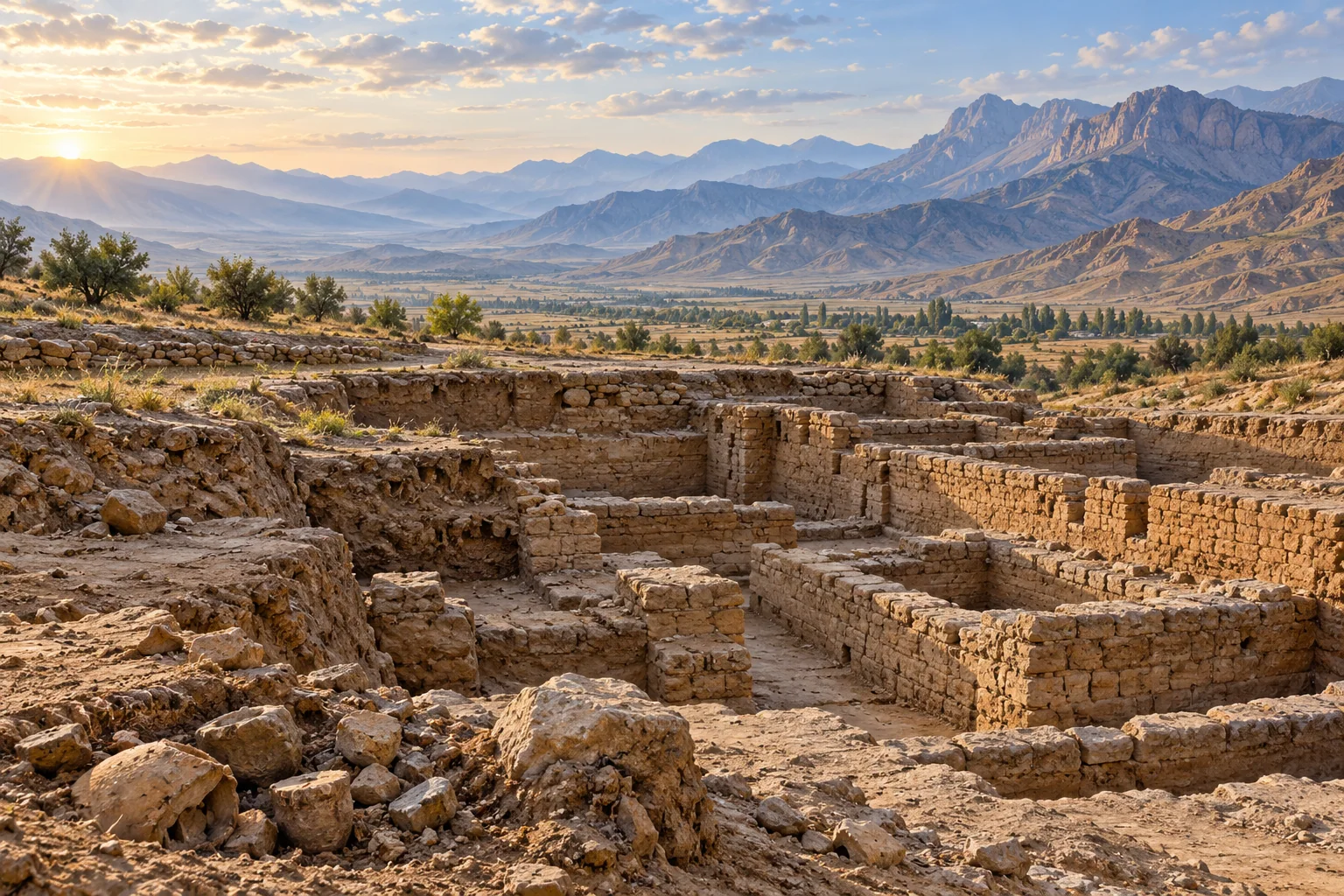
Hegmataneh’s identification as a Median and later capital is part of the question. An excavation report rejects a Median date for the architecture it investigated, so the dates of particular structures matter.
Iran · c. 540–740 CE (tentative sampled-structure interval)
These points locate named sites or parts of a listed property. They show geographic references, not ancient borders or excavation plans. They make no claim about present-day sovereignty.
● Published reference point. Natural Earth public-domain land outline. No political boundaries are shown. The map does not capture scrolling.
Published heritage-property reference point; not an excavation coordinate or ancient boundary. Present-day geographic reference for the named site/component; does not date an occupation or establish a territory.
34.8036°, 48.5183° · Coordinate source ↗
N34 48 12.8 E48 31 6
Coordinate source checked 2026-10-27.
Iran
The 2012 excavation report discusses two thermoluminescence results. This tentative material interval is separate from the earlier Median-capital attribution; it does not date the whole site.
The heritage account associates Hegmataneh with Median and later capitals. A primary excavation report rejects Median attribution for the architecture it investigated.
The sampled architecture and the broader history of the site must be kept separate when interpreting the dating results.
Two thermoluminescence results suggest roughly 540–740 CE for sampled architecture, with repair and sampling cautions. This does not disprove earlier occupation elsewhere at the site.
The report’s later dates apply to the architecture and samples it studied. They do not rule out earlier occupation elsewhere at Hegmataneh. The heritage attribution and excavation findings remain distinct accounts.
Source links apply to specific claims. Several links can lead back to the same study. Read what each source supports.
What remains uncertain
Later remains must not all be assigned to a securely bounded Median empire; attribution needs period-specific evidence.
Institutional primary description; introductory synthesis
Description and statement of Outstanding Universal Value
What remains uncertain
This concerns sampled structures, not proof that Median occupation was absent everywhere.
Excavation-report attribution dispute
Abstract; dating discussion, printed pp. 33–34
What remains uncertain
Do not assign that interval to the entire site or suppress the authors’ cautions.
Sample-based dating interpretation
Dating discussion, printed pp. 33–34
The sampled architecture and the broader history of the site must be kept separate when interpreting the dating results.
Limit: Later remains must not all be assigned to a securely bounded Median empire; attribution needs period-specific evidence.
UNESCO World Heritage Centre: Hegmataneh ↓The date of an excavated wall must be tested rather than inherited from a famous city name.
Limit: Later structures cannot simply be called Median.
Mohammadifar, Norouzi and Sharifi (2012): Preliminary Report of the 16th Season of Excavations at Tepe Hegmataneh ↓Literary associations and sampled building dates answer different questions.
Limit: The investigated sample does not settle all site chronology.
Mohammadifar, Norouzi and Sharifi (2012): Preliminary Report of the 16th Season of Excavations at Tepe Hegmataneh ↓Hegmataneh is associated with the Medes and with later imperial periods in a landscape of successive occupation.
Institutional primary web account inspected 27 October 2026; no fieldwork or independent peer review claimed
Several links may describe the same research. Shared authors or data can limit how much independent confirmation they provide.
An explicit challenge to Median attribution of particular excavated architecture.
Primary PDF abstract and dating discussion inspected 27 October 2026; whole report not claimed fully reviewed
Several links may describe the same research. Shared authors or data can limit how much independent confirmation they provide.