
Time and place
Ethiopia
These dates mark the focus of this case, not the full history of the place or its communities.
Connected worlds · Institutions · Ethiopia
1 CE–1300 CE (focus interval)
What survives when a political center changes?
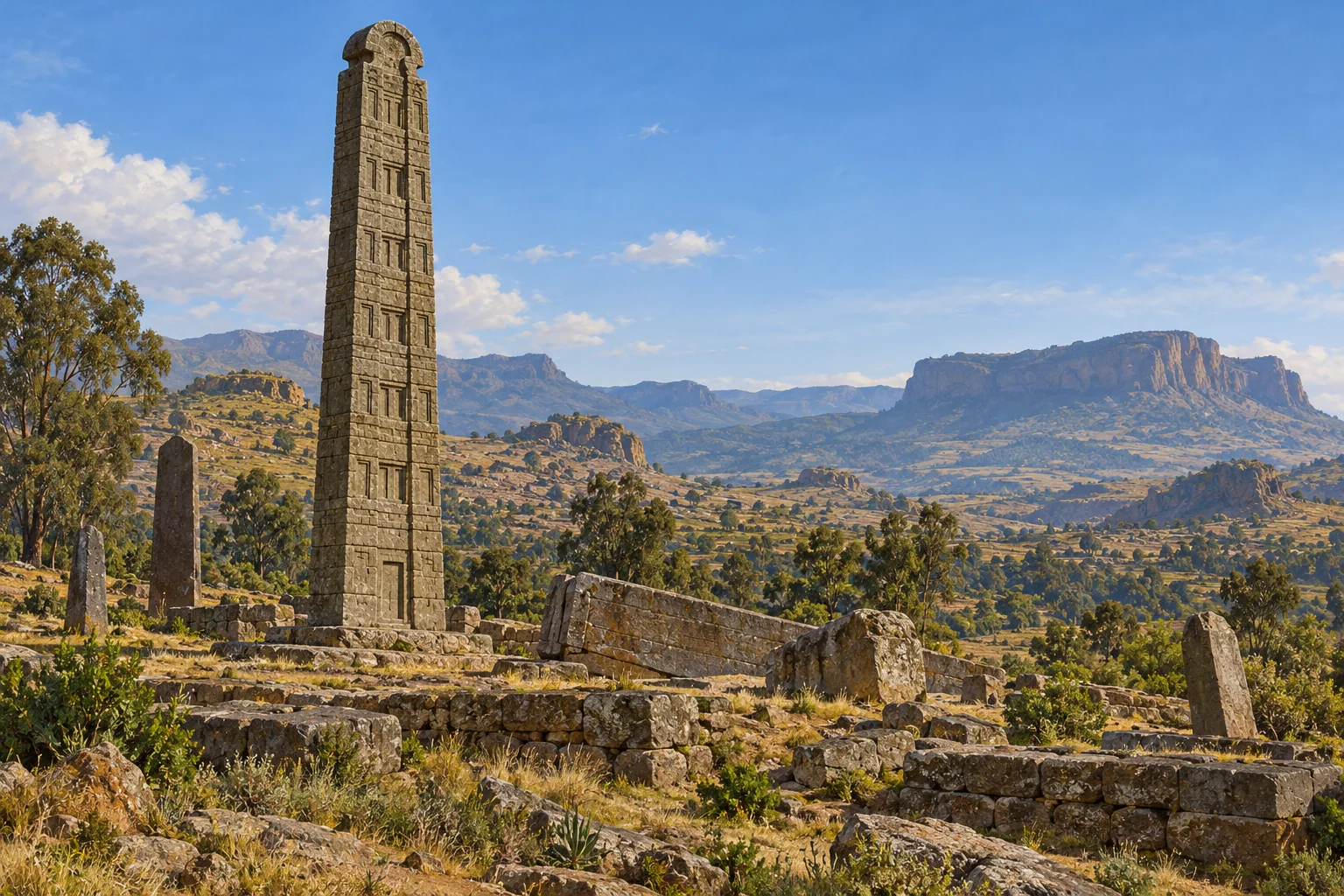
Stelae, royal tombs and palatial ruins survive at Aksum. Excavation and archive records help ask how this center changed, rather than treating its long chronology as a period of unchanged power.
Ethiopia · 1 CE–1300 CE (focus interval)
These points locate named sites or parts of a listed property. They show geographic references, not ancient borders or excavation plans. They make no claim about present-day sovereignty.
● Published reference point. Natural Earth public-domain land outline. No political boundaries are shown. The map does not capture scrolling.
Published heritage-property reference point; not an excavation coordinate or ancient boundary. Present-day geographic reference for the named site/component; does not date an occupation or establish a territory.
14.1302°, 38.7186° · Coordinate source ↗
N14 7 48.684 E38 43 6.996
Coordinate source checked 2026-10-27.
Ethiopia
These dates mark the focus of this case, not the full history of the place or its communities.
Aksum preserves monumental stelae, royal tombs and ruined palatial structures.
The archive also points to homes and farming settlements, widening the questions beyond the most visible monuments.
The wide heritage chronology is not a period of unchanged political power or a complete account of Horn networks.
Only the first rendered page of the excavator’s report was inspected. The archive and report belong to the same research effort; the remaining report and monograph pages still need review.
Source links apply to specific claims. Several links can lead back to the same study. Read what each source supports.
What remains uncertain
The wide heritage chronology is not a period of unchanged political power or a complete account of Horn networks.
Institutional primary description; introductory synthesis
Description and statement of Outstanding Universal Value
What remains uncertain
Earlier does not supply a precise calendar date; the report explicitly leaves the platforms' purpose uncertain.
Primary research or collection account; access and inference limits apply
Annales d'Éthiopie 10, p.325: trenches, platforms and uncertainty
What remains uncertain
An archive overview is not a completed review of the underlying domestic-economy studies.
Primary research or collection account; access and inference limits apply
Introduction: 1972–74 and 1993–97 research
The archive also points to homes and farming settlements, widening the questions beyond the most visible monuments.
Limit: The wide heritage chronology is not a period of unchanged political power or a complete account of Horn networks.
UNESCO World Heritage Centre: Aksum ↓The excavator traced stone-built platforms beneath the stelae sequence using stratigraphic trenches.
Limit: Earlier does not supply a precise calendar date; the report explicitly leaves the platforms' purpose uncertain.
Neville Chittick: Aksum 1973–1974 excavations (1976) ↓The BIEA archive also points toward residential and farming-settlement research, widening the questions beyond the most visible stelae.
Limit: An archive overview is not a completed review of the underlying domestic-economy studies.
BIEA Aksum archive: introduction ↓Aksum preserves monumental stelae, royal tombs and ruined palatial structures.
Institutional primary web account inspected 27 October 2026; no fieldwork or independent peer review claimed
Several links may describe the same research. Shared authors or data can limit how much independent confirmation they provide.
Stratigraphic trenches showed platforms preceding stelae; their purpose and precise dating were unresolved.
Original excavator's report, rendered page 325 inspected; not a full monograph review
Several links may describe the same research. Shared authors or data can limit how much independent confirmation they provide.
Archive documents residential/burial excavations and later architecture, farming-settlement and burial research.
Archive introduction and collection provenance inspected
Several links may describe the same research. Shared authors or data can limit how much independent confirmation they provide.