
Time and place
China
These dates mark the focus of this case, not the full history of the place or its communities.
Connected worlds · Belief · China
366 CE–1400 CE (focus interval)
What can a place of devotion preserve about movement?
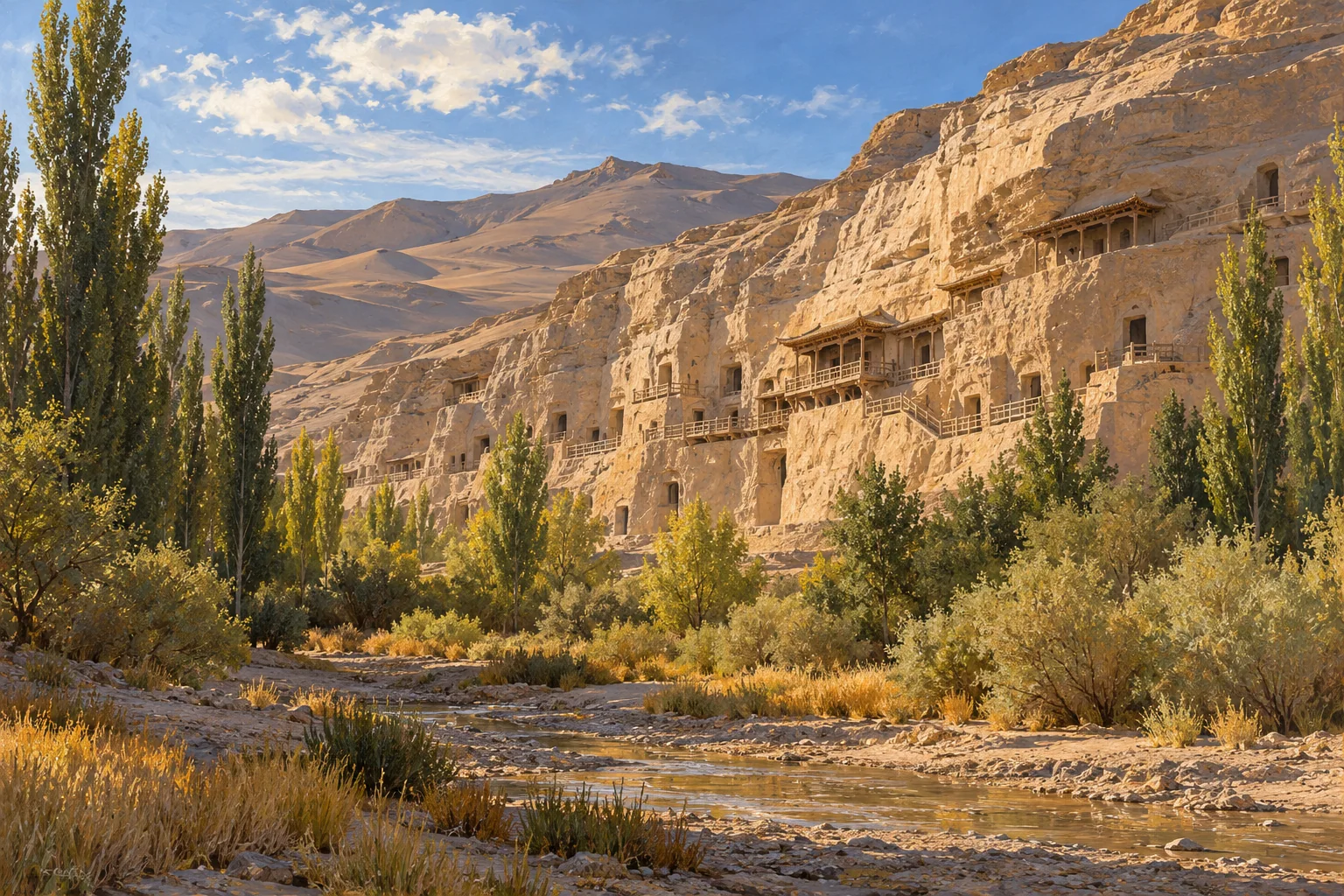
Mogao’s 492 decorated caves preserve Buddhist art spanning roughly a millennium. Manuscripts add evidence of languages and bookmaking, while their later dispersal shapes what researchers can study today.
China · 366 CE–1400 CE (focus interval)
These points locate named sites or parts of a listed property. They show geographic references, not ancient borders or excavation plans. They make no claim about present-day sovereignty.
● Published reference point. Natural Earth public-domain land outline. No political boundaries are shown. The map does not capture scrolling.
Published heritage-property reference point; not an excavation coordinate or ancient boundary. Present-day geographic reference for the named site/component; does not date an occupation or establish a territory.
40.1333°, 94.8167° · Coordinate source ↗
N40 7 59.988 E94 49 0.012
Coordinate source checked 2026-10-27.
China
These dates mark the focus of this case, not the full history of the place or its communities.
Mogao contains 492 decorated caves with Buddhist art spanning roughly a millennium.
A text’s language, format and collection history need to be considered alongside the cave setting.
This focus does not cover all Tang-to-Qing China, or identify the origin of ceramics found elsewhere.
The manuscript-project pages belong to one collection-research program. They do not provide separate corroboration or permission to reuse images. This case does not cover all Tang-to-Qing China.
Source links apply to specific claims. Several links can lead back to the same study. Read what each source supports.
What remains uncertain
This focus does not cover all Tang-to-Qing China, or identify the origin of ceramics found elsewhere.
Institutional primary description; introductory synthesis
Description and statement of Outstanding Universal Value
What remains uncertain
Languages preserved in one deposit do not census everyone living in Dunhuang.
Primary research or collection account; access and inference limits apply
Manuscripts; Chinese-Tibetan concertina manuscript; Religious texts
What remains uncertain
A preserved format alone does not establish a direct route of influence.
Primary research or collection account; access and inference limits apply
Manuscripts; Chinese-Tibetan concertina manuscript; Religious texts
What remains uncertain
Collection history and the original deposit's arrangement are not the same thing; the original arrangement is partly unknown.
Primary research or collection account; access and inference limits apply
Wang Yuanlu's discovery; arrival of Stein; dispersal of items
A text’s language, format and collection history need to be considered alongside the cave setting.
Limit: This focus does not cover all Tang-to-Qing China, or identify the origin of ceramics found elsewhere.
UNESCO World Heritage Centre: Mogao ↓The cave's manuscripts include Chinese, Tibetan and other languages. One concertina manuscript places Chinese commentary beside a Tibetan sutra layout.
Limit: Languages preserved in one deposit do not census everyone living in Dunhuang.
British Library/IDP: What was stored in Cave 17? ↓Scrolls, loose-leaf pothi formats and bound books preserve changing ways of making and reading texts.
Limit: A preserved format alone does not establish a direct route of influence.
British Library/IDP: What was stored in Cave 17? ↓Wang Yuanlu's discovery and later transfers to foreign collectors shaped the dispersed corpus that readers encounter today.
Limit: Collection history and the original deposit's arrangement are not the same thing; the original arrangement is partly unknown.
British Library/IDP: Discovering Cave 17 ↓Mogao contains 492 decorated caves with Buddhist art spanning roughly a millennium.
Institutional primary web account inspected 27 October 2026; no fieldwork or independent peer review claimed
Several links may describe the same research. Shared authors or data can limit how much independent confirmation they provide.
Cave 17 preserves multilingual manuscripts, different book formats and bilingual layouts.
Manuscripts, bilingual concertina and religious-text sections inspected
Several links may describe the same research. Shared authors or data can limit how much independent confirmation they provide.
The Library Cave's materials were found in 1900 and later dispersed among collections.
Discovery, Stein/Pelliot encounters and dispersal sections inspected
Several links may describe the same research. Shared authors or data can limit how much independent confirmation they provide.