
Time and place
Mexico
These dates mark the focus of this case, not the full history of the place or its communities.
Connected worlds · Writing · Mexico
500 CE–700 CE (focus interval)
What do buildings and reliefs preserve together?
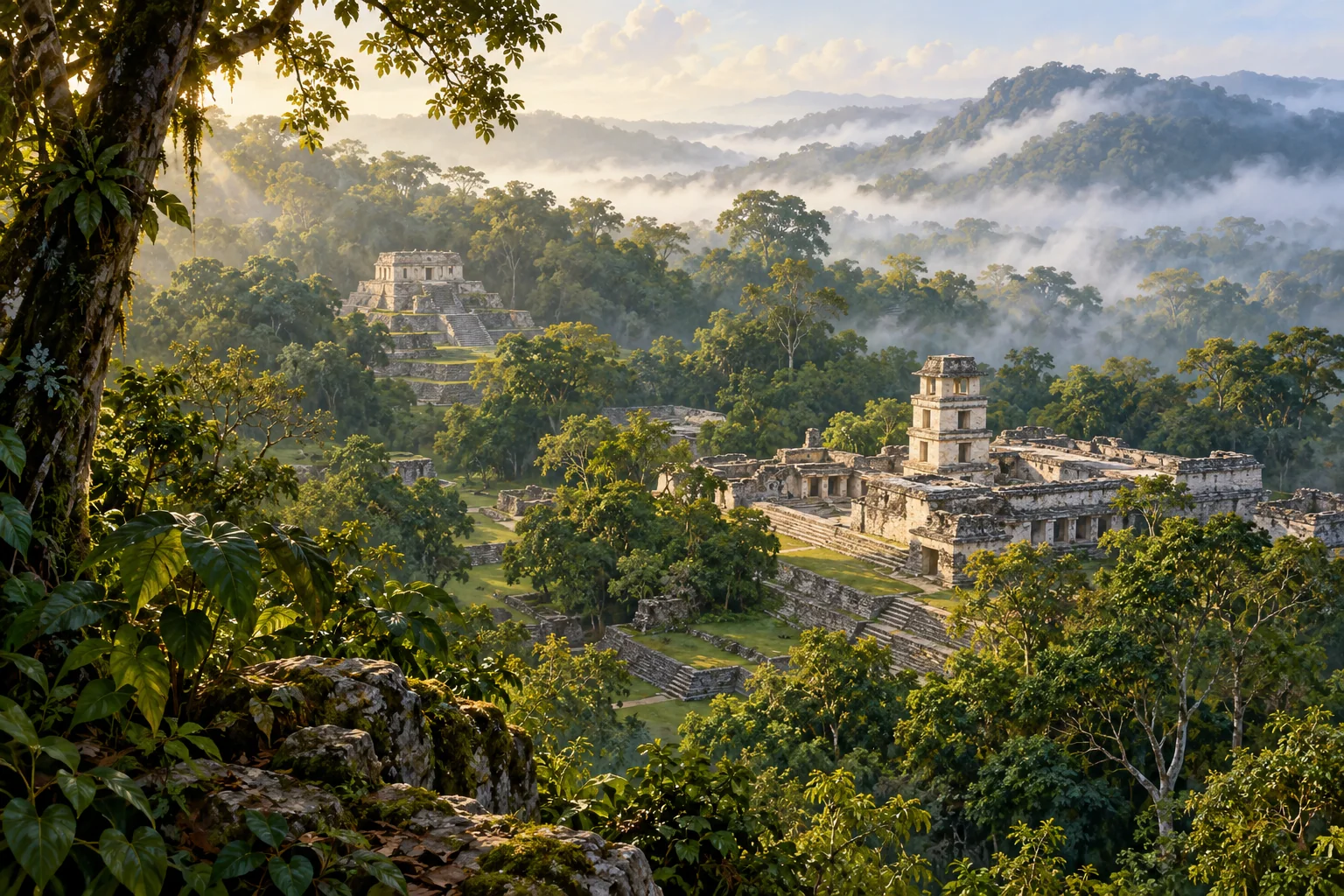
Palenque’s buildings and sculpted reliefs record major development in the sixth and seventh centuries CE. Architectural research provides a view of this particular city, not a single picture of Maya life.
Mexico · 500 CE–700 CE (focus interval)
These points locate named sites or parts of a listed property. They show geographic references, not ancient borders or excavation plans. They make no claim about present-day sovereignty.
● Published reference point. Natural Earth public-domain land outline. No political boundaries are shown. The map does not capture scrolling.
Published heritage-property reference point; not an excavation coordinate or ancient boundary. Present-day geographic reference for the named site/component; does not date an occupation or establish a territory.
17.4833°, -92.0500° · Coordinate source ↗
N17 28 59.988 W92 2 60
Coordinate source checked 2026-10-27.
Mexico
These dates mark the focus of this case, not the full history of the place or its communities.
Palenque contains architecture and sculpted reliefs associated with its major development in the sixth and seventh centuries CE.
The dates used here concern the selected buildings and questions. Maya peoples and histories extend beyond them.
Maya peoples are living communities; the focus interval is not the beginning or end of Maya history.
The fieldwork and analysis support particular architectural claims, not every historical inference. Community applicability remains open. Article images carry CC BY-NC-ND terms and have not been treated as unrestricted reuse assets.
Source links apply to specific claims. Several links can lead back to the same study. Read what each source supports.
What remains uncertain
Maya peoples are living communities; the focus interval is not the beginning or end of Maya history.
Institutional primary description; introductory synthesis
Description and statement of Outstanding Universal Value
What remains uncertain
Digitally integrated evidence improves architectural comparison; it is not fresh excavation of every hidden space.
Primary research/institutional source, bounded finding
Methods; Results
What remains uncertain
A tripartite layout proposed for unexcavated spaces remains an inference, not direct observation.
Primary research/institutional source, bounded finding
Abstract; Conclusions
The dates used here concern the selected buildings and questions. Maya peoples and histories extend beyond them.
Limit: Maya peoples are living communities; the focus interval is not the beginning or end of Maya history.
UNESCO World Heritage Centre: Palenque ↓Digital recording can test relationships between buildings while retaining the distinction between measured surfaces and inferred hidden chambers.
Limit: Elite funerary structures do not reconstruct every household or the whole Maya world.
Campiani, Liendo Stuardo & Lercari (2022), The Mausoleum Architectural Project ↓Palenque contains architecture and sculpted reliefs associated with its major development in the sixth and seventh centuries CE.
Institutional primary web account inspected 27 October 2026; no fieldwork or independent peer review claimed
Several links may describe the same research. Shared authors or data can limit how much independent confirmation they provide.
2018 laser scanning/photogrammetry combined with legacy drawings to test elite funerary architecture.
Primary full-text Abstract, Methods, Results and Conclusions inspected
Several links may describe the same research. Shared authors or data can limit how much independent confirmation they provide.