
Time and place
Peru
Primary AMS study abstract: remains from four cemeteries support occupation approximately 1420–1532 CE. The interval does not date every structure or the whole Inca realm.
Connected worlds · Settlement · Peru
c. 1420–1532 CE (AMS-supported occupation interval)
How does a built place work with a steep landscape?
Terraces, ramps and buildings at Machu Picchu were fitted to an Andean mountain setting. Dating evidence helps examine the site’s occupation, without dating every structure or all of Tawantinsuyu.
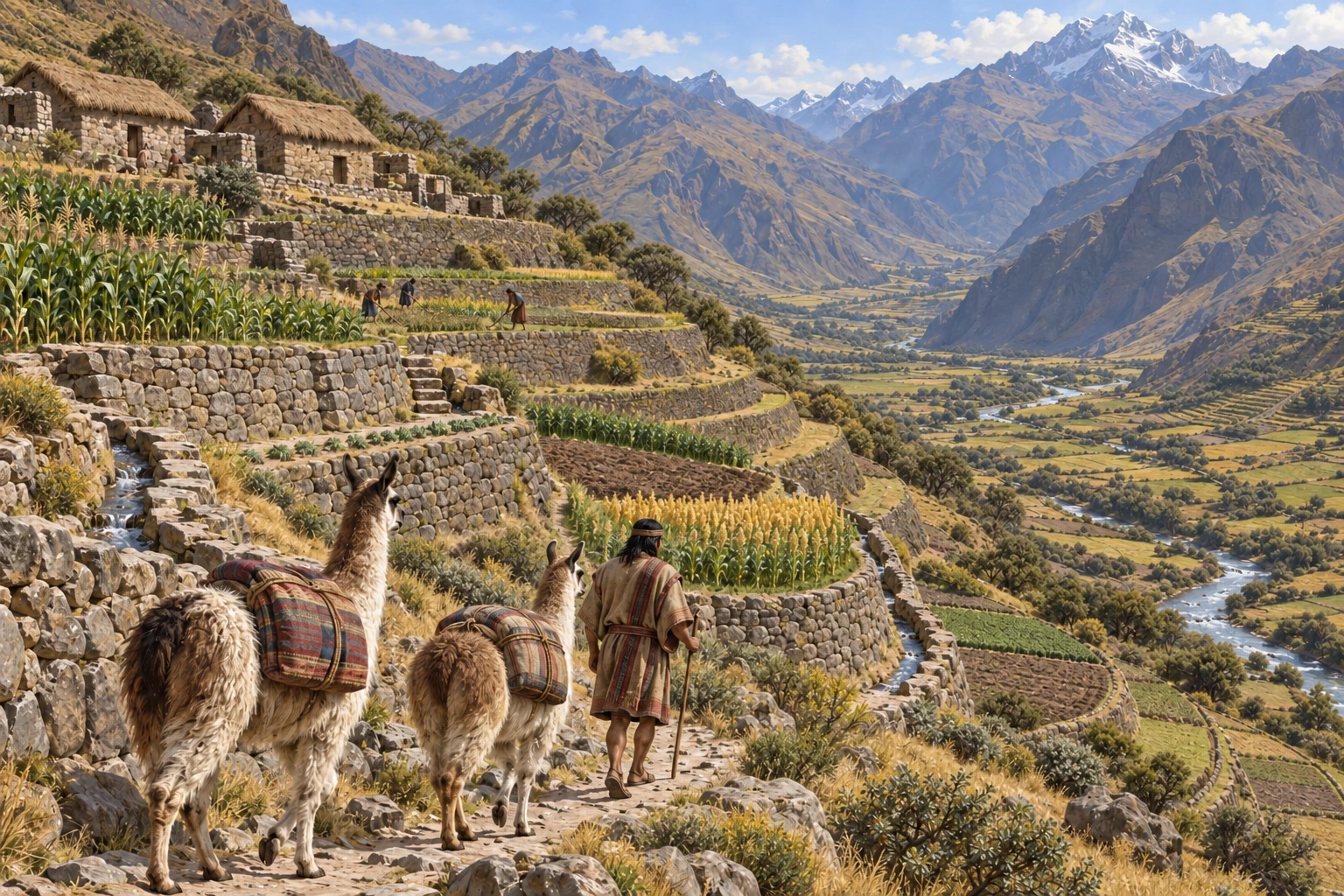
Peru · c. 1420–1532 CE (AMS-supported occupation interval)
These points locate named sites or parts of a listed property. They show geographic references, not ancient borders or excavation plans. They make no claim about present-day sovereignty.
● Published reference point. Natural Earth public-domain land outline. No political boundaries are shown. The map does not capture scrolling.
Published heritage-property reference point; not an excavation coordinate or ancient boundary. Present-day geographic reference for the named site/component; does not date an occupation or establish a territory.
-13.1849°, -72.5334° · Coordinate source ↗
S13 11 5.762 W72 32 0.395
Coordinate source checked 2026-10-27.
Peru
Primary AMS study abstract: remains from four cemeteries support occupation approximately 1420–1532 CE. The interval does not date every structure or the whole Inca realm.
Machu Picchu preserves terraces, ramps and built structures in an Andean mountain setting.
The sampled remains and the buildings around them are different kinds of evidence.
This is one site, not all of Tawantinsuyu. The dates do not describe every occupation or the histories of living Andean communities.
The radiocarbon study is a separate analytical source from the heritage summary; university news about that paper is the same study. Its full model and sampling sections still need review before claiming a comprehensive chronology. Image and human-remains reuse requires separate decisions.
Source links apply to specific claims. Several links can lead back to the same study. Read what each source supports.
What remains uncertain
This is one site, not all of Tawantinsuyu. The dates do not describe every occupation or the histories of living Andean communities.
Institutional primary description; introductory synthesis
Description and statement of Outstanding Universal Value
What remains uncertain
This estimates site occupation from a burial sample; it does not date every building or all Inca history.
Primary research/institutional source, bounded finding
Abstract
The sampled remains and the buildings around them are different kinds of evidence.
Limit: This is one site, not all of Tawantinsuyu. The dates do not describe every occupation or the histories of living Andean communities.
UNESCO World Heritage Centre: Machu Picchu ↓Burial-based radiocarbon evidence can challenge a chronology inferred mainly from written accounts.
Limit: The inspected abstract does not expose the full sampling/model details; those remain a review step.
Burger et al. (2021), New AMS dates for Machu Picchu ↓Machu Picchu preserves terraces, ramps and built structures in an Andean mountain setting.
Institutional primary web account inspected 27 October 2026; no fieldwork or independent peer review claimed
Several links may describe the same research. Shared authors or data can limit how much independent confirmation they provide.
AMS chronology of bone/tooth samples from four cemeteries.
Primary publisher abstract inspected; full article not available through the retrieved abstract page
Several links may describe the same research. Shared authors or data can limit how much independent confirmation they provide.