
What this record covers
Occupation contexts in Siberia and on the Tibetan Plateau. This record concentrates on published Baishiya case studies; it does not treat Denisova and Baishiya as one named culture or claim a complete Denisovan bibliography.
EARLY CULTURAL WORLDS · DEEP TIME
Identifying Denisovans depends on molecular evidence as well as context. At Baishiya, a jaw and a later rib provide the clearest links to the lineage, while animal remains provide evidence of subsistence. This evidence does not establish that every object in the cave came from the same population.
Central and East Asia · c. 300,000–30,000 years ago
This reading frame spans several archaeological contexts. No single point represents the whole case.
Place the observations in context before drawing a wider conclusion.
Occupation contexts in Siberia and on the Tibetan Plateau. This record concentrates on published Baishiya case studies; it does not treat Denisova and Baishiya as one named culture or claim a complete Denisovan bibliography.
Very few fossils are securely identified; most tools cannot yet be tied to a specific lineage, and the Denisovan population history was deeply structured.
These selected studies support the examples below. This is not an exhaustive review or a claim that later research cannot change the interpretation.
Each case pairs a reported finding with the limit of the inference.
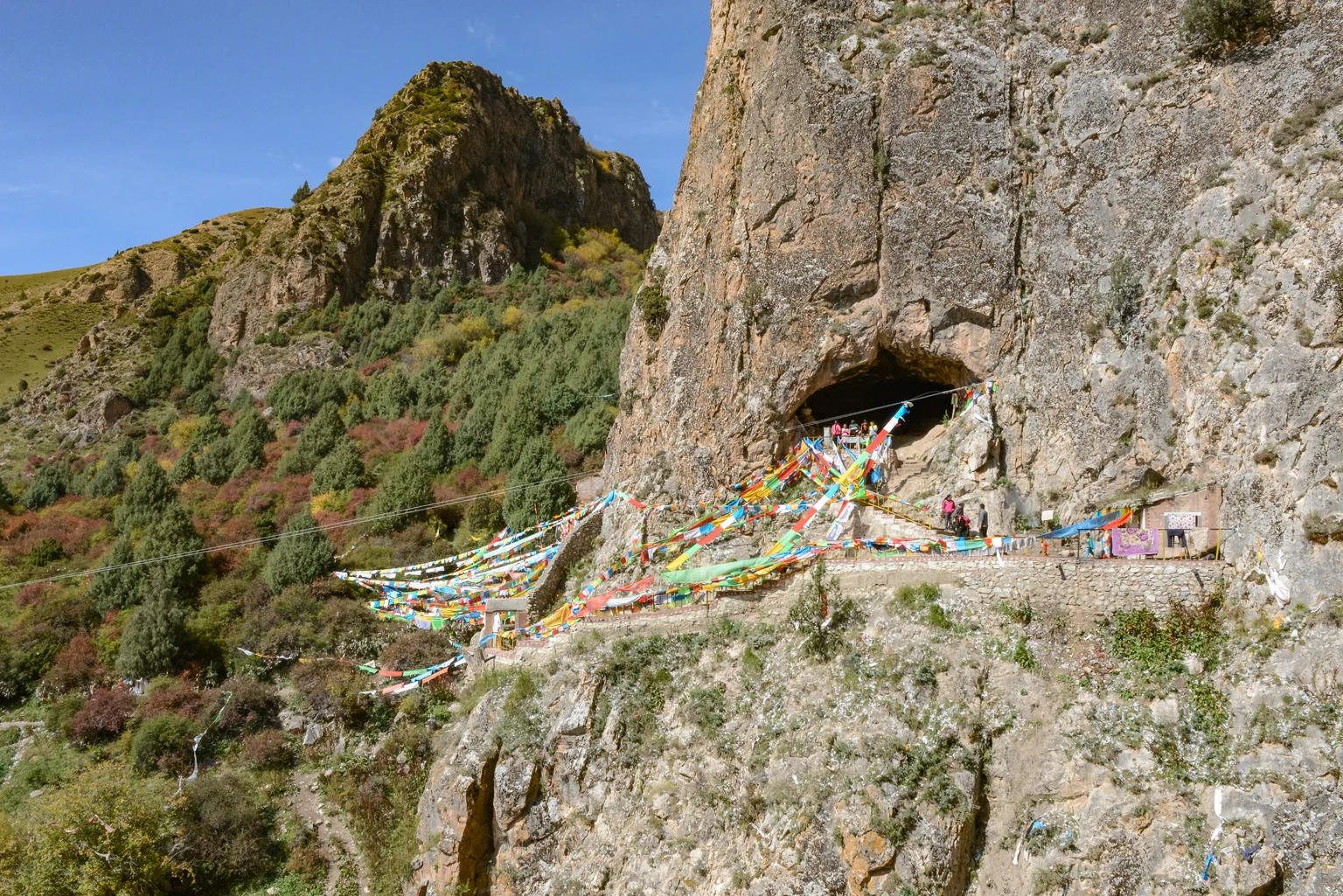
The 2019 study used ancient proteins to identify the Xiahe mandible from Baishiya Karst Cave as Denisovan. It established a Denisovan presence on the Tibetan Plateau beyond the original Siberian fossil locality.
The 2024 Baishiya study identified a Denisovan rib from a layer dated approximately 48,000–32,000 years ago. Animal bones show processing for food and other resources; the authors infer Denisovans were the main accumulating agent in the studied sequence.
Use these prompts to separate a material observation from an interpretation.
Inspect the original research. Multiple links do not automatically mean independent corroboration.
Protein-based attribution of the mandible and high-altitude occupation.
The rib's molecular attribution, layer-age estimate and animal-processing evidence.