
Time and place
Italy
These dates mark the focus of this case, not the full history of the place or its communities.
Connected worlds · Settlement · Italy
100 BCE–500 CE (focus interval)
How does a city preserve several pasts at once?
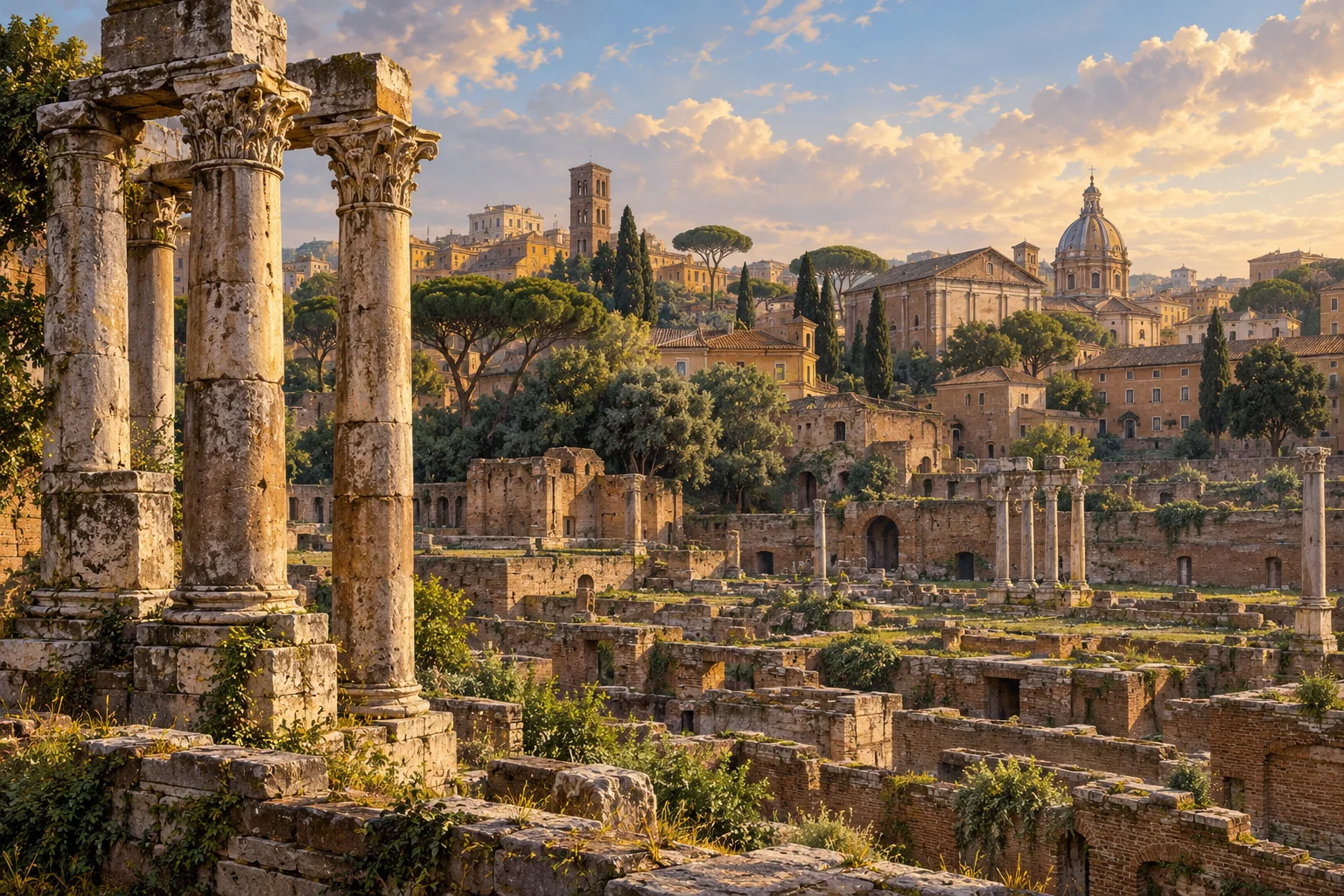
Rome’s historic center contains republican, imperial and later religious monuments. Reading the city means distinguishing when buildings were made, what they were used for and how they survived.
Italy · 100 BCE–500 CE (focus interval)
These points locate named sites or parts of a listed property. They show geographic references, not ancient borders or excavation plans. They make no claim about present-day sovereignty.
● Published reference point. Natural Earth public-domain land outline. No political boundaries are shown. The map does not capture scrolling.
Published heritage component reference; not excavation geometry or ancient territorial boundary. Present-day geographic reference for the named site/component; does not date an occupation or establish a territory.
41.8902°, 12.4923° · Coordinate source ↗
91quater-001 · Historic Centre of Rome · Italy · N41 53 24.8 E12 29 32.3
Coordinate source checked 2026-10-27.
Italy
These dates mark the focus of this case, not the full history of the place or its communities.
The historic center contains monuments from republican, imperial and later religious histories.
Later reuse and preservation are part of the evidence, rather than an endpoint imposed by this page’s dates.
These dates focus on Roman layers. They do not mark an end to the city or to the wider Roman and Byzantine worlds.
The archaeological park describes the site, while the Caesar’s Forum team describes its own project. Detailed excavation findings still require the relevant publications; a DAI article could not be retrieved.
Source links apply to specific claims. Several links can lead back to the same study. Read what each source supports.
What remains uncertain
These dates focus on Roman layers. They do not mark an end to the city or to the wider Roman and Byzantine worlds.
Institutional primary description; introductory synthesis
Description and statement of Outstanding Universal Value
What remains uncertain
Functions changed over time and do not describe every neighborhood or inhabitant.
Primary research or collection account; access and inference limits apply
Historical description, paragraphs 1–7 (formation, monuments and reuse)
What remains uncertain
Later survival is not evidence that an ancient institution continued unchanged.
Primary research or collection account; access and inference limits apply
Historical description, paragraphs 1–7 (formation, monuments and reuse)
What remains uncertain
The project overview does not supply detailed excavation results for every claim about Rome.
Primary research or collection account; access and inference limits apply
The Caesar's Forum Project: project description
Later reuse and preservation are part of the evidence, rather than an endpoint imposed by this page’s dates.
Limit: These dates focus on Roman layers. They do not mark an end to the city or to the wider Roman and Byzantine worlds.
UNESCO World Heritage Centre: Rome ↓The Forum's monuments served political, religious, commercial and judicial activities; a single surviving building type does not exhaust the city's public life.
Limit: Functions changed over time and do not describe every neighborhood or inhabitant.
Parco archeologico del Colosseo: The Roman Forum ↓Some monuments survived through conversion into churches. What remains visible therefore reflects later adaptation as well as ancient construction.
Limit: Later survival is not evidence that an ancient institution continued unchanged.
Parco archeologico del Colosseo: The Roman Forum ↓Modern excavation is itself a separate layer of evidence: the Caesar's Forum Project combines Danish and Italian research and heritage partners.
Limit: The project overview does not supply detailed excavation results for every claim about Rome.
Aarhus UrbNet: The Caesar's Forum Project ↓The historic center contains monuments from republican, imperial and later religious histories.
Institutional primary web account inspected 27 October 2026; no fieldwork or independent peer review claimed
Several links may describe the same research. Shared authors or data can limit how much independent confirmation they provide.
The Forum developed over successive periods and buildings acquired later uses.
Official site's historical account inspected
Several links may describe the same research. Shared authors or data can limit how much independent confirmation they provide.
A separate modern Danish-Italian research excavation examines the Forum of Caesar area.
Research project's description and team/funding sections inspected; linked excavation paper timed out
Several links may describe the same research. Shared authors or data can limit how much independent confirmation they provide.