
Observed in fossils, artifacts, molecules or dated contexts.
CLAIM-LEVEL DOSSIER · REVIEWED 2026-08-12
Homo neanderthalensis
Neanderthals400,000–40,000 years ago · Europe and western AsiaVERSION 1.0.0-phase1REVIEW DUE 2026-11-128 SOURCED CLAIMS
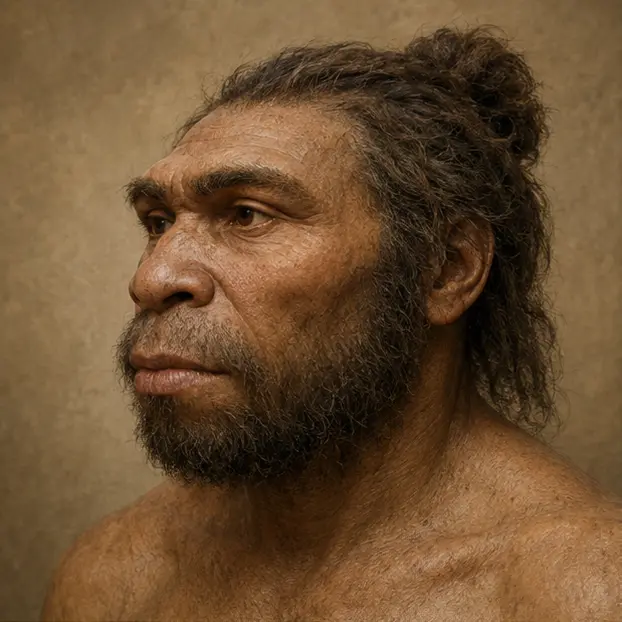
Current synthesis
A deeply adapted Eurasian human lineage with sophisticated technologies, social care and a living genetic legacy.
HOW TO READ THIS DOSSIER
How strong is the evidence?
Multiple lines of evidence support the interpretation.
The best-supported synthesis, with missing details supplied cautiously.
Plausible, but alternatives remain viable.
Specialists dispute the evidence, attribution or interpretation.
Retained to explain an older claim, not presented as current fact.
INDIVIDUAL CLAIMS · SOURCES · LIMITS
What the evidence supports.
Each claim lists its stable ID, evidence type, place, time period, review date and limits.Chronologyhigh confidence
Neanderthals persisted across major climatic shifts and vanished near 40,000 years ago.
Neanderthals were a distinct Eurasian human lineage present for hundreds of thousands of years and disappeared from the dated record by about 40,000 years ago.
- Evidence
- Direct evidence
- When
- Approx. 400,000–40,000 years ago
- Where
- Europe and western to central Asia
- Limit
- The beginning of the lineage depends on which fossils are classified as Neanderthal or ancestral Neanderthal.
Relationshipshigh confidence
Some Neanderthals and early members of our species had children together; parts of that ancestry survive today.
Neanderthals exchanged genes with Homo sapiens, and Neanderthal-derived DNA persists in living populations.
- Evidence
- Direct evidence
- When
- Multiple contacts; major shared episode roughly 50,000 years ago
- Where
- Eurasia; legacy in living populations
- Limit
- Ancestry percentages vary among individuals and populations; a single global percentage is misleading.
Social lifehigh confidence
At one cave, researchers identified relatives within the same community context.
Genome data from Chagyrskaya Cave include close biological relatives and are consistent with a small local community with sex-biased mobility.
- Evidence
- Strong inference
- When
- Around 54,000 years ago
- Where
- Altai Mountains, Siberia
- Limit
- One regional community cannot define Neanderthal social organization across their full range and history.
Diethigh confidence
There was no single Neanderthal menu. Diet changed with place, climate and available resources.
Neanderthal diets varied by ecology and included animal and plant foods; dental calculus preserves site-specific dietary and microbial evidence.
- Evidence
- Direct evidence
- When
- Middle and Late Pleistocene
- Where
- Site-specific across Eurasia
- Limit
- Dental calculus samples are few and do not measure everything eaten or the proportion of each food.
Constructionhigh confidence
They organized material and maintained activity far beyond daylight inside a cave.
Neanderthals arranged broken stalagmites in structures deep inside Bruniquel Cave around 176,000 years ago.
- Evidence
- Direct evidence
- When
- Approx. 176,000 years ago
- Where
- Bruniquel Cave, France
- Limit
- The structures' specific purpose is unknown; ritual, shelter and other functions cannot be distinguished securely.
Symbolic behaviormoderate confidence
The talons were selected and worked; interpreting the exact object remains a reconstruction.
White-tailed eagle talons from Krapina were deliberately modified and probably assembled as a personal ornament or symbolic object.
- Evidence
- Probable reconstruction
- When
- Approx. 130,000 years ago
- Where
- Krapina, Croatia
- Limit
- No cord or complete assembled object survives, so the final arrangement and meaning are inferred.
Clothingmoderate confidence
They almost certainly protected their bodies with worked hides in cold regions; the outfits shown in art are interpretations.
Cold-climate energetics and hide-working technology strongly support Neanderthal clothing, but no complete garment establishes its cut or appearance.
- Evidence
- Strong inference
- When
- Cold phases of the Middle and Late Pleistocene
- Where
- Cold Eurasian environments
- Limit
- Clothing need, hide processing and preserved garments are different evidence categories; regional variation was likely.
Technologyhigh confidence
Tar adhesive use is established. It does not, by itself, support sweeping claims about intelligence.
Neanderthals used tar adhesives in hafted technologies, but tar production by itself does not prove a particular level of cognition.
- Evidence
- Direct evidence
- When
- Middle Palaeolithic
- Where
- Multiple European contexts
- Limit
- Production methods differed and some may be simpler than earlier experimental reconstructions assumed.
Anatomy
Large brain, projecting midface, strong body and cold-adapted proportions with substantial regional variation.
Ecology & food
From steppe and woodland to coasts and mountains.
Technology
Mousterian and later regional industries, hafting, fire, hide work, pigments and ornaments.
Clothing evidence
Hide working and cold-climate requirements support clothing, but no complete Neanderthal garment survives. Every cut and fastening shown is a bounded reconstruction.
Behavior & social evidence
Care for injured people, complex hunting, plant cooking and symbolic practices are supported at multiple sites.
Relationships
Interbred with Homo sapiens and Denisovan-related populations.
Controversies
Timing and causes of disappearance, authorship of transitional industries and how broadly symbolic evidence generalizes.
What reaches forward
Most people with ancestry outside Africa carry some Neanderthal-derived DNA.
SOURCE DESK